What is worse than a philandering marriage therapist, an obese dietician, or a lying ethics counselor? A conceited man of G-d. The two are mutually exclusive; you are either a servant of G-d or a servant of your ego. There is a story of an ethics professor caught cheating on his taxes who defended himself by saying, “My colleague teaches algebra; does that mean he has to become a triangle?”
In the secular world, knowledge may be academic, but in the spiritual world, you cannot give what you do not have. To help others, you must first find the truth within yourself. If we try to give what we don’t have, we fail others and ourselves. This was the practice of the second Chabad Rebbe, Rabbi Dov Ber of Lubavitch. He refused to counsel others on their faults until he found a refined version of that same flaw within himself. Only after he plotted his own way out would he lead others toward the light.
The Silent Night
In this week’s Torah portion, Moses informs the Jewish people that G-d desires a home among them. This was astounding news. Less than three months earlier, they had worshipped the Golden Calf. This invitation meant G-d had truly forgiven them, reestablishing the Sinai covenant to dwell among them, and through them, in the world.
Yet, a curious detail emerges: Moses returned from the mountain with the second tablets, bursting with this revelation, but he did not share it immediately. Instead, he spent the entire day and night teaching Torah. He lectured for hours as if he had no other news. Why did he wait?
We can infer that Moses was excited from the people’s eventual response. When he finally spoke, the Jews were so exuberant they flooded the collectors with donations until they had to be begged to stop. They volunteered in droves—carving, weaving, and building. They were ecstatic to be G-d’s ambassadors again. If the people felt this joy, Moses surely felt it a hundredfold. Why, then, the silence?
The Prerequisite of Devotion
The answer lies in the nature of a relationship. To host G-d, you must become a person of G-d. You cannot simply accept His gift of presence and continue living as you did before. While the second tablets symbolized forgiveness, forgiveness is only the beginning. The next step is restoring the relationship.
Restoring a broken relationship requires more than an apology; it requires a demonstration of devotion, loyalty, and trustworthiness. Moses knew that before the people could build a physical home for G-d, they had to “dwell” in His Torah for a while. They had to absorb His wishes, marinate in His thoughts, and internalize His will so they could align their rhythms with the Divine.
You cannot host a guest if you are focused on yourself. To host G-d, you must make space in your heart. If you nurse your wounds, worship your ego, and serve only your own interests, there is no room for G-d. Before G-d could dwell with them, the Jews had to dwell with G-d. Only after a day and night of total immersion in G-dliness did Moses deem them ready to build.
Soul Over Body
The result of this spiritual preparation was a miracle of unity. Ordinarily, when people support a cause, they vie for the limelight. They want to be the “lead donor” or the “master craftsman.” But here, the people worked in lockstep. They did not compete; they coordinated. Even though money usually breeds division, their donations united them.
This happened because they had spent the previous day immersed in the Divine until their souls outshone their egos. Our bodies compete for space, attention, and resources; our souls do not. The body views life as a zero-sum game—if you have more, I have less. But the soul finds its high tide in the happiness of others. Because they went to work as “G-d’s people” rather than “important contributors,” they became instruments of a higher purpose.
The Divine Instrument
Consider the tefillin (phylacteries). When we look at a person wearing tefilin, we see leather boxes, parchment, and straps. But the mitzvah also requires a human arm and head. When you wear tefilin, have you placed them on your arm and head, or are your limbs part of the tefilin, just like the parchment and straps? Are the tefilin-wearing arm and leg your limbs or extensions of the mitzvah—Divine instruments?
Why do you think of the parchment as part of the Mitzvah, but not your arm? Because the arm is part of you, and the parchment is not. (It would be interesting to ask the animal from whose hide the parchment was made, who owns the leather . . .) But when wearing tefilin, does your arm belong to you?
The difference lies entirely in your perspective. If you live through the prism of the body, you own the arm. If you live through the soul, your very limb is a conduit for G-d’s will.
How do we attain this mindset?
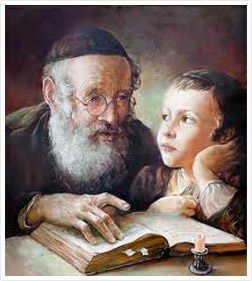
The answer is to begin each day with a fixed period of Torah study. In those moments, forget your agenda and your ego. Practice being an instrument of the Divine. As you study, visualize G-d teaching you the ideas you are reading off the page. Reframe your voice as an echo of G-d’s voice. You are not reading the book; G-d is reading it to you. You are G-d’s student. Fully absorbed. Taking it in.
If you plug into that source every morning with this consciousness, that holiness will spill into the minutiae of your day. You will move through the world not as a person seeking to take, but as an instrument of G-d, ready to serve. You might lose this mindset as the day wears on, but tomorrow morning, you will study again and reconnect once more. Eventually, habit will become second nature.[1]
[1] This essay is based on Likutei Sichos 6, p. 210, Sefer Hasichos 5749:1, p. 296, and Toras Menachem 5732:2, p. 352.