

Articles in Terumah
Terumah: Marriage Tips
The Cherubs
Perched atop the Holy Ark that Moses built, were two golden cherubs that faced each other with their wings extended forward to meet at the center of the ark.[1] When King Solomon built the Temple, he made the Holy of holies twenty cubits in breadth. He then fashioned two …
Terumah: What Is Your Tower
Choose Your Tower
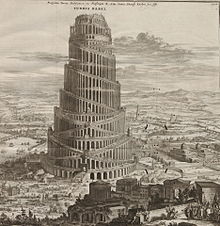
Two Chassidic Rabbis riding in their carriages met in the middle of a bridge. One carriage was pulled by two old horses, the other, by a team of four powerful stallions. The rabbi with the old horses asked the other, why do you need such strong horses? Answered …
Shabbat Zachor: Memory Is A Bridge

Remember
Can you imagine driving down the street and suddenly realizing that you forgot where you are coming from? If you don’t know where you are coming from, you can’t know where you are going or why. Severed from the past, the present has no bridge to the future.
Tweet
Terumah: The Crown
For G-d
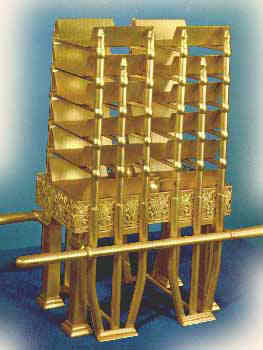
Three of the Temple’s sacred vessels had crowns around their perimeter. There was a crown around the incense altar, a crown around the show-table and a crown around the holy ark. Our sages taught, the crown around the altar was taken by Aaron, whose children were destined for the …
Terumah: The Sanctuary

Why the Replica?
Have you ever noticed that we go out of our way to turn the Sanctuary into a replica of the Bet Hamikdash, the ancient temple?
Our Sanctuaries have arks in which the Torah scroll is housed just as the Temple housed an Ark for the Tablets. The Ark is …
Teruma: Instant Forgiveness
The Pivot
How long does it take you to forgive? Small offenses are quickly forgiven, large offenses take more time to forgive, if at all, but one thing is certain, if someone betrayed you in the worst possible way you would hardly offer instant forgiveness the moment they displayed a desire …
Terumah: Escapism Is Not A Solution
Build A Sanctuary
There is not a neighborhood in the world without drawbacks, nor a community without problems. No matter how lovely the school, synagogue or organization appears on the outside its flaws and fissures are always discovered when we make its acquaintance from the inside. There are always those, who …
Terumah: How To Make A Sanctuary

Four Elements
The tabernacle Moses was commanded to erect comprised the four basic elements, inanimate, vegetative, animate and human. The floor was desert sand, representing the inanimate element. The walls were wooden, representing the vegetative element. The roof was of animal hide, representing the animate element and the people that worshiped …