
Healing the Great Divide
This week’s Torah portion speaks of the mysterious lesions that appeared on the skin of those who trafficked in gossip. Their punishment was at once severe and precise: they were cast into isolation for up to three weeks, until their affliction healed.
The Torah enumerates many forms of ritual impurity. Some bar entry into the Temple; others exclude one from Jerusalem. But the impurity of the metzora is of a different order altogether. It does not merely distance a person from sacred space—it distances him from people. “He shall dwell alone; outside the camp shall his dwelling be” (Leviticus 13:46). He is cut off from human society itself.
Rashi explains that this isolation is measure for measure. One who sowed division between friends and spouses is himself divided from all companionship. Yet this is not only punishment—it is healing. In solitude, the metzora confronts a painful truth: he has rendered himself unfit for relationship. Trust, once broken, is not easily restored.
There is a striking irony here. The gossiper is rarely alone. Gossip requires an audience; it thrives in company. And yet, the metzora is the loneliest of all. No one entrusts him with their secrets. No one turns to him in vulnerability. A true friend is one who holds your most fragile truths and sees you no differently. The metzora forfeits that privilege. Surrounded by people, he lives in profound isolation.
Contemporary Isolationism
In a deeper sense, our generation shares this condition. We are, perhaps, the most connected—and the most lonely—generation in history. Like the metzora, we are surrounded by voices, yet remain profoundly alone. Ours is a loneliness not of absence, but of disconnection.
Thomas Paine once wrote, “These are the times that try men’s souls.” His words echo anew in an age marked by division and rising extremism. Rabbi Jonathan Sacks once suggested that much of this extremism is fueled by anxiety—the unease of a world changing faster than we can absorb, and the certainty that it will change faster still.
Rabbi Sacks taught that to understand a civilization, one must ask: what it worships? In ages past, humanity bowed to the sun, the moon, and the stars. Later it worshipped nations, races, and ideologies. In our day, he argued, we worship the self.
A glance at our cultural landscape confirms it. We pursue self-help, self-expression, and self-actualization. We define morality as authenticity to the self, politics as the defense of personal rights, and even our social interactions as curated exhibitions of the self. The “selfie” has become both symbol and sacrament.
At first glance, this seems liberating. After centuries of constraint, we are finally free. Yet it is a freedom that devours us. Like a man sitting on the deck of the Titanic, nursing a drink. He hears a crash, regards his shattered glass, and observes, “I know I asked for ice, but this is too much.”
In our relentless focus on the self, we erode the very fabric of society. Each week brings new values, new vocabularies, and new identities, each proclaimed in the name of empowerment. But the deeper tragedy lies not just in their emergence, but in our response. Rather than engage across differences, we retreat into echo chambers, surrounding ourselves with those who mirror our views.
Maimonides correctly reminded us that human beings are inherently social. We require real, human encounters to cultivate empathy and trust. Without it, the self becomes brittle—fearful, defensive, and alone. Because when the “I” overwhelms the “we,” isolation follows.
Rabbi Sacks offered a profound insight: the best way to secure the future of the I is to strengthen the future of the us. We are naturally drawn to those who resemble us, yet growth often comes from those who do not. It is precisely the unfamiliar that stretches us, challenges us, and enlarges us.
When we confine ourselves to the comfort of sameness, we don’t deepen—we harden. Our views calcify. Our fears intensify. Cut off from difference, we lose the ability to discern truth from distortion, fact from farce. Those beyond our circle become not merely wrong, but alien—and eventually, less than human.
But when we seek out those who are different, something remarkable happens. Our minds expand. Our perspectives widen. Even when we disagree, we do so from understanding rather than reflex.
The Path to Healing
We must rebuild the human face-to-face connections we have allowed to atrophy. We must relearn the art of conversation—of listening, of disagreeing without disdain, and of holding conviction without hostility. We must rediscover how to argue passionately and yet remain friends.
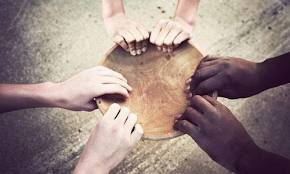
In doing so, we will uncover a simple but transformative truth: those who are not like us are, in the deepest sense, just like us. Each act of genuine connection—each outstretched hand across a divide—mends a fracture in our broken world.
Rabbi Sacks reminded us that the responsibility rests with us. Not with leaders alone, nor even, in a sense, with Heaven. G-d gave us free choice and entrusted this task to our hands. The work of healing belongs to us. We must emerge from the digital enclaves in which we have taken refuge and step back into the shared spaces of human encounter.
When we move from the politics of me to the politics of us, we rediscover the foundations of a healthy society: a nation is strongest when it is compassionate toward the weak, rich when it cares for the poor, and secure when it protects the vulnerable.
The path forward is both simple and demanding: whenever the word self arises in our thinking, we must learn to replace it with other. We have invested deeply in self-help. Now it is time to other-help. Not self-esteem, but other-esteem. Not self-actualization alone, but the actualization of those around us. It is only together that we can become whole.
If we walk hand in hand, there is little we cannot overcome, no fracture we cannot heal. The future need not be feared if it is faced together.
As King David wrote, “Though I walk in the valley of the shadow of death, I will fear no evil, for You are with me” (Psalms 23:4). David spoke of G-d, but Rabbi Sacks suggested that in our time, the message echoes in us, too, for G-d has given us free will and placed this task in our hands.
If we stand together, we need not fear even the darkest valley. Together, we can heal a fractured world.[1]
[1] Rabbi Sacks’ Ted Talk on which this essay is based, can be found at www.youtube.com/watch?v=AMVgX8cXsHA