
Was G-d Kidding?
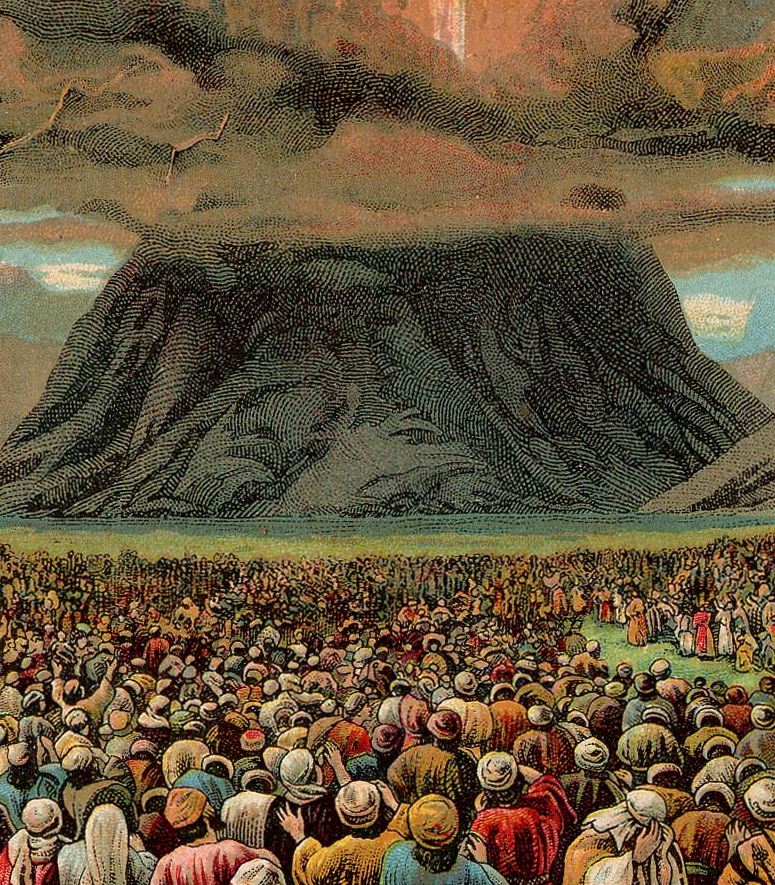
This week, we celebrate Shavuot, the day we received the Torah on Mount Sinai. It was 3338 years ago, in 2448 in the Hebrew calendar. Our ancestors arrived at Sinai six days earlier and spent the time preparing spiritually for this pivotal moment. They resolved their arguments and forged true national unity. They accepted an invitation to be G-d’s chosen people. When asked, they replied, “We will do, and we will listen.” They were primed. They were excited.
What did G-d do during those days?
Well, G-d spent part of those days with Moses, who engaged in shuttle diplomacy scurrying up and down the mountain carrying messages between G-d and the Jews. But G-d spent the rest of the day negotiating with the other nations. G-d approached each of the seventy biblical nations and offered them the Torah.
What Was He Thinking?
Can you believe it? Is this not two-timing? Imagine dating a woman and courting her for marriage, but at the same time, double-timing with another woman in case the first one doesn’t work out. How long would it take for both women to kick you out once they discovered your ruse?
What was G-d thinking? Choosing the Jews on the second of Sivan and offering the Torah to the Moabites on the third of Sivan? And not just the Moabites, but the Hittites, Canaanites, Egyptians, etc. How could G-d betray us like that? And what would G-d have done if one or more of the other nations had also accepted? Would G-d marry both? Would He confer chosen nation status on multiple nations?
Moreover, what was G-d thinking? Were these nations worthy candidates of G-d’s attention? The Midrash tells us how and why each of these nations rejected G-d’s offer. The Edomites asked what was in the Torah, and G-d replied that it contained a prohibition against murder. They refused, saying their tradition, handed down by their father Esau, was to murder and pillage. The Ishmaelites rejected the Torah because of its prohibition against theft. Their traditions, from Ishmael, embraced theft.
And so it was with all the nations until G-d offered the Torah to the Jews. They never asked what was in it. As soon as they heard G-d had a book to give them, they accepted. We will do, and we will listen.
Now, G-d, who knows the future, knew precisely how these nations would respond. So, why did G-d even offer it? Was his offer even serious? He knew they would refuse, and if not, that they were unworthy.
They tell the story of a young engineer fresh out of MIT who was asked in a job interview how much he expected as a starting salary. He said he expected $150,000 plus benefits. The interviewer asked, “What would you say to a benefits package with five weeks vacation, 14 paid holidays, full medical and dental, a matching retirement fund to 50% of salary, and a company car leased every two years?” The kid says, “Wow! Are you kidding?” The interviewer replies, “Yeah, but you started it.”
So, was G-d kidding?
Softening the Ground
G-d gave the Torah to the Jewish people. His intention was not that we hoard it for ourselves, but that we become a light unto the nation, teaching them the precepts of Monotheism and the Noahide laws. Ultimately, we were meant to funnel the Torah’s influence to the entire world. This is partly why the Jews are dispersed throughout the world. It enables the Torah’s influence to reach the entire globe.
Yet, as we read above, the nations were not willing to study the Torah. The Talmud (Sotah 35b) teaches that before entering Israel, the Jews inscribed the entire Torah on twelve large monuments for the nations to learn. In the end, no one came to read or study it. Similarly, G-d gave the nations the Noahide laws in Noah’s days, but no one kept them (Avodah Zarah 2b).
It was almost unfair to ask Jews to disseminate the Torah to all the nations when they were so resistant to the Torah’s message. This is why G-d offered the Torah to the nations. G-d knew they would reject it, but the very offer softened the ground.[1] It opened them to the possibility of the Torah penetrating their borders. What had been considered ludicrous before was now a compelling idea they had to reject.
A tiny crack appeared in their resistance to the Jewish message. It began with a trickle of isolated converts, but over time, monotheism spread throughout the world and now has billions of adherents.
Global Sparks
In the parlance of Kabalah, when G-d Created the world, He embedded Divine sparks in all parts of the world. Every nation controls the sparks embedded within its territory. So long as they reject the Torah, these sparks remain unrealized. Their immense spiritual power is co-opted by the nations to endow them with prosperity and political power. Some nations are more prosperous and powerful than others because their territories contain more Divine sparks.
But these are not the intended use of the sparks. These sparks are in a state of imprisonment among these nations. They are co-opted to parlay their power into corporeal materialistic blessings. The true character of these Divine sparks is to inspire minds, hearts, and souls to G-d. For this, they require Jews to reside among them who study and adhere to the Torah. This liberates the sparks among the nations and frees them to do the work they were designed to do.
When all the sparks throughout the world are liberated, humanity’s task will be complete, and the Mashiach, the era of reward, will be ushered in.
Yet, it was known to G-d that the nations would resist the Jewish influence. They would restrict Jews and deny them religious freedoms. They would oppress the Jews to make it difficult for them to live a Jewish lifestyle in their countries. All this to bar the Jews access to the nation’s sparks.
G-d knew it would be difficult, so He softened the way by loosening up the sparks. G-d visited every nation in their homeland and brought the Torah with Him. The nations rejected G-d and dispatched Him as G-d knew they would. However, G-d’s very presence weakened the power of the nations to resist the Torah. It loosened up the divine sparks and made it possible for us to release them.
G-d spent much of the courtship days at Sinai negotiating with the nations to pave our path after Sinai. It was not a betrayal. It was G-d’s effort to ensure our success. (Panim Yafot, Devarim 33:2)
The Sparks at Work
So the next time you are traveling in a distant country and are struck by the natural beauty of a mountain range, an ocean, or a sunrise, and you think of G-d, know that a Divine spark in the vicinity is at work. Embrace the moment and do a Mitzvah. Put on tefilin, give a coin to tzedakah, study some Torah, or pray. This way, the spark will fulfill its purpose, and you will grant it its freedom.
[1] Similarly, our sages taught that angels teach a Jewish fetus the entire Torah, but the fetus forgets it before birth. The benefit of learning and forgetting is that the next time we learn it, it feels familiar and is readily absorbed.